An Aluminium Door Profile may look like a simple frame, but its performance depends on details hidden in plain sight. Alloy choice, wall thickness, thermal breaks, corner joints, and surface finish all affect strength, comfort, and service life. A poorly matched profile can cause sticking doors, cold interior edges, or finish wear around a busy entrance. Small details matter.
Architect Ludwig Mies van der Rohe’s well-known phrase, “God is in the details,” offers a useful lens for comparing manufacturers. It is not an aluminium specification, of course. Still, it captures why careful design and consistent production deserve close attention. This guide examines ten worldwide manufacturers through practical criteria: product range, engineering capability, quality controls, customization, certifications, and regional support. Buyers should verify current specifications and test reports directly, since product lines and standards can vary by market.
A polished catalogue is not enough. Look for clear section drawings, realistic lead times, reliable installation guidance, and evidence that finishes withstand the intended environment. We also consider how well each supplier explains trade-offs, such as insulation performance versus profile size. The comparison has limits. Public information is uneven, and no ranking can replace project-specific testing or a qualified technical review. Use it as a starting point, then match each profile to the building, climate, and door hardware it must serve.
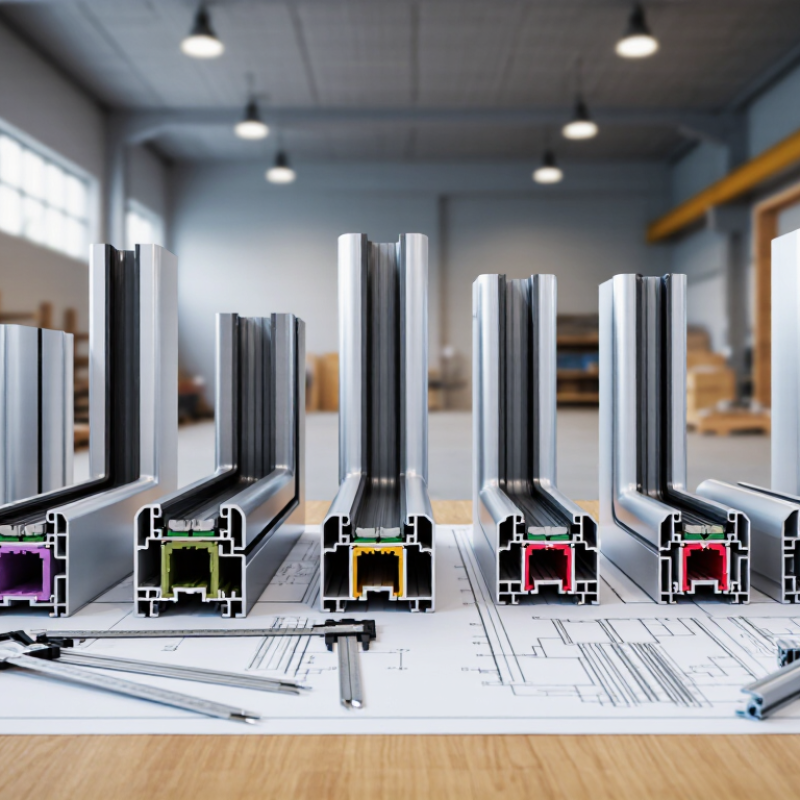
Aluminium door profiles are designed around the opening, expected loads, and local climate. Engineers select the frame depth, wall thickness, and reinforcement after checking door size and hardware. The profile must also leave room for glazing, seals, drainage paths, and locks. Small details matter. A misplaced drainage slot can trap water, while a shallow gasket channel may weaken the seal. Thermal-break designs use insulating strips between inner and outer aluminium sections to reduce heat transfer.
Manufacturing usually begins with an alloy billet heated and pressed through a shaped steel die. The emerging profile is cooled, stretched straight, and cut to length. Then it may be aged for strength and finished with powder coating or anodizing. Clean surfaces are essential. Even a tiny mark can become visible after finishing. CNC machining creates hinge seats, screw holes, and lock openings, which must match the drawings closely.
Quality checks compare dimensions against specified tolerances and inspect corners, coatings, and assembly fit. Sample frames can reveal problems before full production, especially around corner joints and moving hardware. A drawing can look precise and still miss a site condition. That is worth remembering. Installers may encounter uneven masonry, so profile design and production tolerances should allow practical adjustment without compromising the seal or door operation.
Assessing global aluminium door profile manufacturers requires more than comparing catalogues. Check whether alloy grades, temper, and dimensional tolerances are clearly documented. Ask for inspection records covering wall thickness, straightness, and coating consistency. A profile may look flawless under showroom lights yet show uneven color or scratches after handling. Details matter.
Surface treatment deserves close attention. Request relevant test results for coating adhesion and corrosion resistance, and confirm how samples are tested. For thermally broken profiles, examine the thermal barrier, assembly method, and stated performance data. Ask how production changes are controlled between sample approval and repeat orders. Even careful checks miss something. Factory audits and references can help, though one visit cannot prove every shipment will match.
Tips: Compare physical samples against drawings, including corner joints and drainage channels. Ask about traceability, packaging, lead times, and procedures for handling defects. If a supplier cannot explain a tolerance in plain language, pause and clarify it. A small inconsistency may be acceptable in one project, but costly in another.
The ten leading aluminium door profile manufacturers worldwide are best compared by engineering consistency, not glossy catalogues. A capable producer controls alloy quality, extrusion tolerances, and surface treatment across repeat orders. Ask for section drawings, finish specifications, and test data for the exact profile series. Small details matter.
For residential projects, check how the frame handles drainage, thermal breaks, and common glazing thicknesses. In coastal settings, coating performance deserves extra attention; a polished finish alone proves little. Request samples with corner joints and seals installed, then inspect alignment and water paths. Numbers help, but only when they describe the configuration you plan to buy. Some brochures blur product ranges, so verify each claim in writing.
Manufacturing scale can support reliable supply, yet it does not guarantee careful technical support. Evaluate response times, replacement-part availability, and the clarity of fabrication guidance. A sample corner may reveal more than a full-page product claim. Compare warranty terms and independent test reports where available. No single shortlist fits every project; price, climate, installation skill, and local service can change the sensible choice. I would treat any global ranking as a starting point, not a final verdict.
Comparing aluminium door profile manufacturers worldwide is less about counting catalog pages and more about checking how well each range suits real projects. Look for systems covering sliding, hinged, and folding doors, with compatible frames, tracks, seals, and hardware. A sample corner joint can reveal more than polished product photos. Check the finish for even color, clean edges, and consistent coating. Details matter.
Quality claims deserve practical evidence. Ask for profile dimensions, alloy specifications, coating information, and test reports for air, water, and wind performance. Compare tolerances, too; a small mismatch can complicate installation or affect how a door closes. No single specification tells the whole story. Some suppliers publish extensive data but offer limited customization, while others provide flexibility with less documentation. That gap is worth noting.
International reach involves more than shipping to many countries. Reliable manufacturers should explain packaging, lead times, technical support, and how replacement parts are handled across regions. Clear drawings and responsive guidance can prevent costly confusion between design and installation teams. Compare these services alongside product quality, not as an afterthought. A wide export network sounds impressive, but delivery consistency may vary by destination. Check references where possible, and keep room for uncertainty when comparing claims.
Aluminium door profile manufacturing is shifting toward lighter sections, tighter tolerances, and more deliberate material use. Designers are refining internal chambers to improve stiffness without adding unnecessary weight. In production, computer-controlled extrusion and inline measurement can help detect dimensional drift before profiles reach cutting and assembly. Small variations matter. A poorly aligned thermal break can affect both fit and insulation performance.
Recycled aluminium is gaining attention because it can reduce demand for primary metal, though its quality depends on sorting and processing. Manufacturers are also adjusting alloy selection and heat treatment to balance strength, surface finish, and machinability. Powder coatings now offer a broad range of textures, including fine matte finishes that hide fingerprints better than glossy surfaces. Still, a finish sample may look different under warehouse lighting. That detail is easy to miss.
Digital tracking is becoming more practical, too. Batch records can connect alloy data, extrusion settings, coating conditions, and inspection results. This helps production teams investigate issues such as uneven color or a door that binds at one corner. Automation improves repeatability, but it cannot replace careful checks on seals, corners, and hardware interfaces. Progress is uneven. Smaller production runs can make advanced monitoring costly, and customization sometimes complicates standard testing. That trade-off deserves more attention.
A global industry indicator relevant to the material supply behind aluminium door profiles; figures are not specific to door-profile manufacturers.
Production rose from 63.7 million tonnes in 2019 to 70.6 million tonnes in 2023. Source: International Aluminium Institute (IAI), global primary aluminium production statistics.
Engineers consider the opening size, expected loads, climate, and hardware. They also allow space for glass, seals, drainage, and locks.
These dimensions affect strength and hardware fit. Reinforcement may be needed for larger doors or heavier loads. Small design choices can have real consequences.
A heated alloy billet is pressed through a shaped die. The profile is cooled, straightened, cut, and may be aged and finished.
It is an insulating strip between inner and outer aluminium sections. The strip helps reduce heat transfer.
Inspect dimensions, corners, coating, and assembly fit. Look closely at hinge seats, screw holes, and lock openings. Small marks show.
Request records for wall thickness, straightness, coating consistency, and dimensional tolerances. Compare physical samples with the drawings.
Ask for test results on coating adhesion and corrosion resistance. Confirm how samples are tested and how finish consistency is checked.
These areas can reveal assembly or water-management problems before full production. A drawing can still miss site conditions. I would check twice.
Ask how production changes are controlled after sample approval. Also confirm traceability, packaging, lead times, and defect procedures. One factory visit proves little.
This article explores how an Aluminium Door Profile moves from initial design to finished product, including the selection of suitable materials, shaping methods, surface treatments, and quality checks. It also explains the main criteria for evaluating manufacturers, such as product consistency, engineering capabilities, range of available profiles, production capacity, and ability to serve customers across different markets.
The article surveys ten leading manufacturers worldwide without focusing on any single brand, comparing their product offerings, quality standards, and international reach. It also considers how changing architectural needs and production priorities are influencing the industry. Emerging trends include greater attention to energy efficiency, durable finishes, design flexibility, and more resource-conscious manufacturing. Together, these topics offer readers a practical framework for understanding the global market and assessing what matters when choosing aluminium door profiles.

Aoli Aluminum