China has become a major source of Construction Aluminum Profiles for global building projects. Its manufacturers serve windows, doors, curtain walls, façades, railings, and industrial systems. However, factory size alone does not prove reliability.
This guide examines leading Chinese manufacturers through practical purchasing criteria. These include alloy consistency, extrusion capacity, surface treatment, tooling control, inspection procedures, and export experience. It also considers common standards, such as EN, ASTM, GB, and Qualicoat requirements, where applicable. Buyers should request current certificates and test reports. Old documents are not enough.
Factory capability matters in real projects. A strong supplier can explain billet grades, wall thickness tolerance, coating thickness, and packaging methods. Sample profiles should show clean corners, uniform color, accurate dimensions, and protected surfaces. Production records and third-party inspections can add confidence. They do not remove every risk.
No ranking stays correct forever.
Markets change quickly. Equipment may be upgraded, management may change, and quality can vary between production batches. Some manufacturers communicate well but lack specialized experience. Others offer excellent engineering support but have longer lead times. This article therefore presents a balanced comparison, not an absolute verdict. It helps architects, contractors, distributors, and project owners shortlist suitable partners. Readers should still verify factory licenses, technical drawings, samples, references, payment terms, and after-sales responsibilities before placing an order. Careful checking remains essential, especially for large façade systems where small dimensional errors can create costly installation problems.
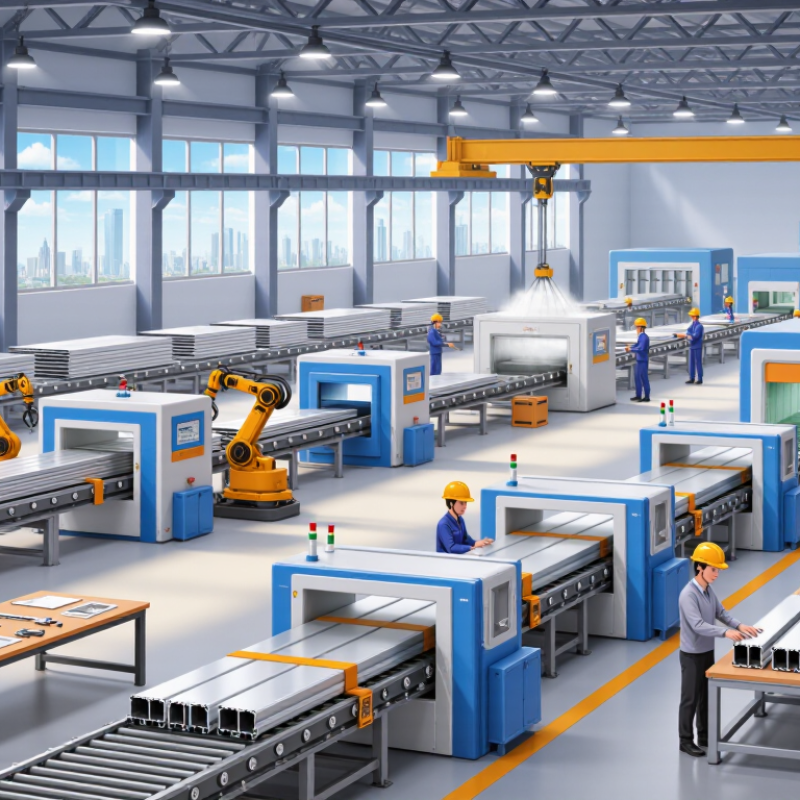
Construction aluminum profiles are shaped aluminum sections used to build frames, supports, edges, and architectural features. They are usually made through extrusion, where heated aluminum passes through a die. This process creates consistent shapes, such as channels, angles, tubes, and thermal-break frames.
They appear in curtain walls, windows, doors, partitions, ceilings, and solar shading systems. On a construction site, installers value their light weight and accurate dimensions. A two-meter profile can be carried easily, yet it may provide strong support when properly designed. Aluminum also forms a protective oxide layer, helping it resist ordinary outdoor corrosion. Powder coating or anodizing can improve appearance and surface durability.
Choosing a profile requires more than checking its shape. Engineers should review alloy strength, wall thickness, span, connection details, wind loads, and exposure conditions. A coastal project may need greater attention to surface protection and fastener compatibility. Poorly matched screws can create staining or galvanic corrosion.
The term “construction aluminum profile” is not always used consistently. Some suppliers describe decorative trims as structural profiles, although their load capacity is limited. That difference matters. A profile that looks rigid may bend under a long span. Product drawings, test data, and applicable building standards should be examined before approval. In practice, small dimensional errors can complicate installation. Careful measurement remains essential.
| Data Dimension | Technical Information | Typical Construction Relevance |
|---|---|---|
| Definition | Construction aluminum profiles are aluminum sections manufactured through an extrusion process to create fixed cross-sectional shapes. | Used for doors, windows, curtain walls, partitions, railings, façades, sunshades and structural framing. |
| Most Common Alloy | Aluminum alloy 6063 is widely used for architectural extrusions because it offers good extrudability, surface finish and corrosion resistance. | Suitable for visible architectural frames and profiles requiring anodizing or powder coating. |
| Higher-Strength Alloy Option | Alloy 6061 provides higher mechanical strength than 6063 in comparable tempers, although it is generally less suitable for highly detailed architectural extrusion. | Used where load-bearing performance is more important than the finest surface appearance or most complex profile geometry. |
| Common Tempers | T5 is typically cooled after extrusion and artificially aged. T6 is solution heat-treated and artificially aged for higher strength. | Temper selection affects strength, dimensional stability, machining behavior and design calculations. |
| Typical Density | Approximately 2.70 g/cm³, or 2,700 kg/m³, depending on alloy composition. | Aluminum profiles are substantially lighter than steel profiles of comparable volume, helping reduce dead load and handling weight. |
| Elastic Modulus | Approximately 69 GPa for common wrought aluminum alloys. | Deflection can govern the design of long-span frames, curtain-wall mullions and large openings, even when strength is adequate. |
| Thermal Conductivity | Common aluminum alloys typically conduct heat at approximately 160–220 W/m·K. | Thermal breaks, insulating strips and suitable glazing details are often required for energy-efficient building envelopes. |
| Standard Surface Finishes | Mill finish, anodized finish, powder coating, liquid coating and wood-effect decorative finishes are commonly available. | Finishing improves appearance and can enhance resistance to weathering, abrasion and corrosion when properly specified. |
| Anodizing Thickness | Architectural anodizing is commonly specified in nominal thickness classes such as 10, 15, 20 or 25 micrometres, subject to the applicable specification. | Higher coating classes are generally selected for more demanding exterior exposure and durability requirements. |
| Powder-Coating Thickness | Typical architectural powder-coating specifications are often within approximately 40–120 micrometres, depending on the coating system and project requirements. | The required coating class should reflect ultraviolet exposure, humidity, pollution, coastal conditions and expected service life. |
| Extrusion Process | A heated aluminum billet is pressed through a die to form the required cross-section, then the profile is cooled, stretched, cut and aged. | Custom dies allow integrated grooves, cavities, screw channels, drainage paths and thermal-break pockets. |
| Dimensional Control | Important controls include wall thickness, straightness, twist, corner dimensions, length tolerance and profile geometry. | Tighter tolerances may be needed for interlocking frames, glazing systems, sliding assemblies and precision fabrication. |
| Relevant Standards | Common references include GB/T 5237.1 for aluminum building profiles, EN 755 for extruded products, EN 12020 for precision profiles and ASTM B221 for extruded aluminum products. | The project specification should identify the governing standard, alloy, temper, finish, inspection method and acceptance criteria. |
| Corrosion Considerations | Aluminum forms a protective oxide layer, but corrosion risk can increase in coastal, industrial or chemically aggressive environments. | Design should address drainage, coating quality, galvanic isolation and contact with incompatible metals. |
| Sustainability Attribute | Aluminum can be recycled repeatedly, and recycling requires far less energy than primary aluminum production. | Recycled content, end-of-life recovery and documented material sources can support project sustainability objectives. |
| Key Selection Criteria | Evaluate alloy and temper, profile geometry, wall thickness, tolerances, surface finish, corrosion exposure, thermal performance and testing documentation. | A technically suitable profile should satisfy structural, architectural, thermal, fabrication and compliance requirements rather than being selected by price alone. |
Note: Mechanical properties, coating thicknesses and dimensional tolerances vary by alloy, temper, profile geometry, applicable standard and project specification. Values shown are general technical references and should be verified against certified product documentation.
Reliable manufacturers combine modern extrusion equipment, experienced engineers, and stable quality control. They deliver accurate dimensions across repeated orders. Samples matter. Their strongest proof is consistent performance, not advertising.
6063 and 6061 are common choices for construction applications. The correct alloy depends on load, surface finish, and machining needs. Alloy selection should match the project. A familiar alloy is not always the best one.
Look for extrusion presses, die-design facilities, aging ovens, and finishing lines. Useful finishing equipment includes powder coating and anodizing systems. Cutting, drilling, and CNC machining may also be available. Equipment lists need verification.
They commonly produce window and door sections, curtain-wall mullions, and thermal-break systems. Other products include sunshades, handrails, structural profiles, and partition sections. Custom extrusions may support façades and modular buildings. Product names alone prove little.
Helpful services include die design, extrusion, aging, cutting, machining, and surface finishing. Manufacturers may also provide color matching and project-based packaging. Thermal-performance testing can support system selection. Confirm every service before ordering.
Request alloy verification, dimensional inspection, and coating-thickness records. Adhesion, hardness, and corrosion-resistance test data can reveal finishing quality. Confirm tolerances in writing. Missing records create avoidable uncertainty.
Samples show dimensions, finish, drainage details, and protective-film performance. They can expose problems before expensive tooling and production begin. A catalog can mislead. Approve a physical sample before placing a large order.
Factory audits can reveal poor storage, weak packaging, and unclear batch labels. Check how profiles are protected from damage and moisture. Small details expose process discipline. Audits are useful, but they cannot predict everything.
Not necessarily. Price should follow technical fit, traceability, delivery reliability, and after-sales response. Low quotations may hide tooling costs or structural assumptions. Cheap can become expensive. This deserves careful reflection.
Confirm alloy, temper, wall thickness, finish, tolerances, tooling fees, and lead time. Review drawings carefully with the technical team. Ask how price changes relate to material and energy costs. Rushed quotations often conceal assumptions.
Construction Aluminum Profiles are engineered aluminum components used in building systems such as doors, windows, curtain walls, partitions, façades, and structural frameworks. China has become an important manufacturing base because its producers often combine large-scale extrusion capacity, advanced surface treatment, flexible customization, and competitive production efficiency. Leading manufacturers typically provide profile design support, mold development, extrusion, cutting, machining, welding, coating, anodizing, assembly, packaging, and logistics coordination.
When evaluating Chinese aluminum profile manufacturers, buyers should consider material standards, alloy and temper options, dimensional accuracy, surface quality, production capacity, testing procedures, quality certifications, delivery reliability, and communication efficiency. It is also important to review technical drawings, request samples, confirm minimum order quantities, and clarify tooling ownership, inspection requirements, packaging methods, and after-sales support. A suitable supplier should demonstrate consistent quality, transparent pricing, responsive service, and the ability to deliver customized Construction Aluminum Profiles that meet the project’s performance, appearance, and installation requirements.

 Aoli Aluminum